 下载格隆汇APP
 下载诊股宝App
 下载汇路演APP

 社区
社区
 会员
会员
“The summit signals a shift from LLMs to Embodied AI in software, medicine and scientific research.
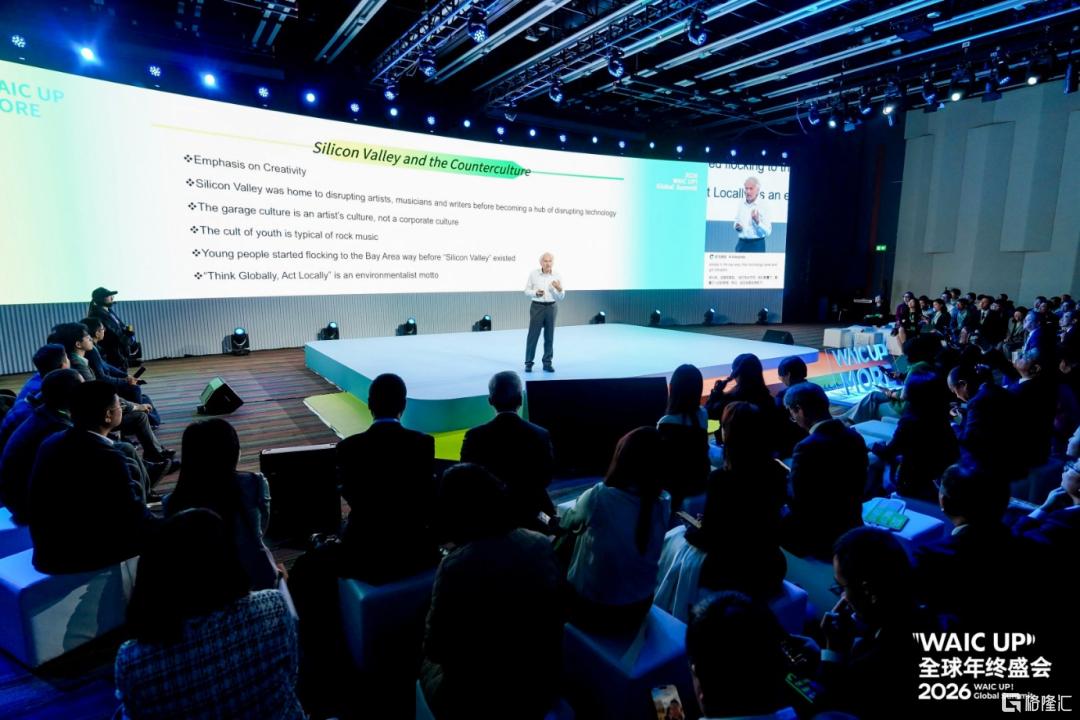
For the first time, the World Artificial Intelligence Conference (WAIC)—Shanghai' s flagship AI forum and one of the world' s most influential AI events—staged its year-end summit in Hong Kong, underscoring the city's growing role as a global gateway for China' s AI ambitions.
Under the theme "WAKE UP MORE!", the summit drew more than 1,000 attendees from across the global tech ecosystem. DataYuan’s editorial team on the ground observed from 10:30 a.m.to 6 p.m., founders, scientists, professors and investors packed a marathon agenda aimed at answering one central question: what exactly is AI changing right now?
A Strategic Pivot: Hong Kong as the Global AI Headquarters
WAIC has long been rooted in Shanghai' s industrial AI strength, home to foundational model developers such as MiniMax and StepFun and applied AI leaders spanning healthcare (United Imaging),education (Squirrel AI) and governance (Xiao-i Robot).
But 2026 marks a strategic evolution for WAIC.
DataYuan reporters at the summit noted by establishing its overseas headquarters in Hong Kong and hosting the WAIC UP! Global Summit there, organizers are positioning the city as a neutral launchpad between China' s AI scale and the global market. The move leverages Hong Kong's regulatory openness, capital mobility and proximity to the Greater Bay Area.
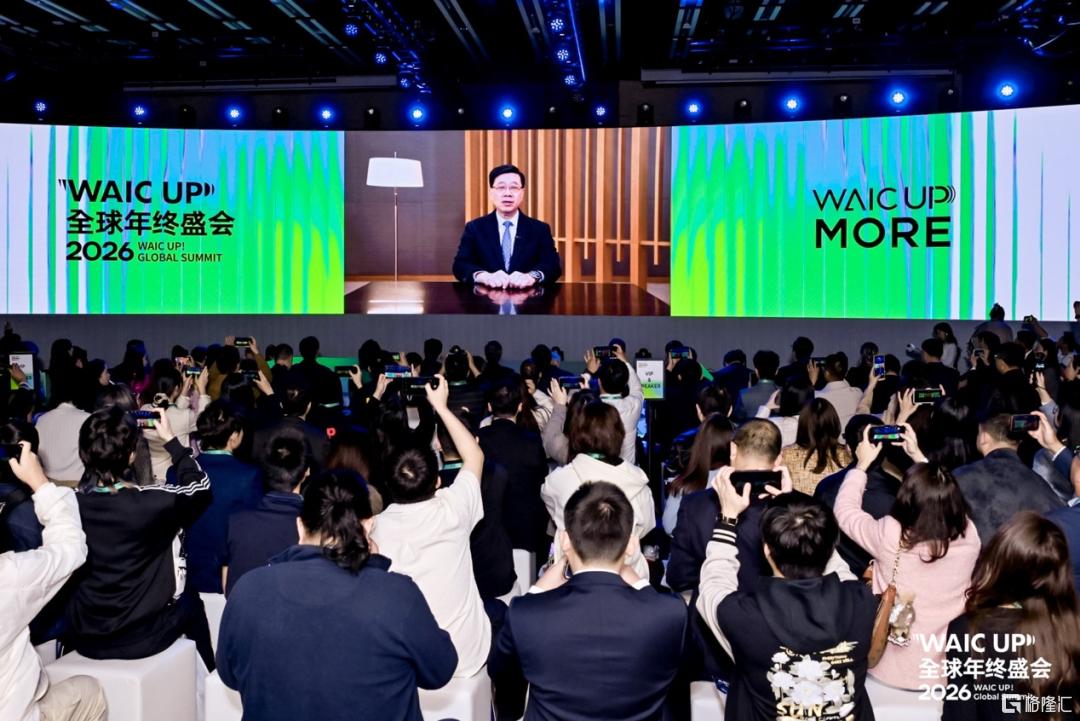
John Lee Ka-chui’s video address at WAIC Up!
Chief Executive for the Hong Kong Special Administrative Region, John Lee Ka-chiu emphasized in his video address that the city is no longer just a financial hub but a "dual-engine" metropolis. Under the "one country, two systems" framework, he said, Hong Kong is uniquely positioned to combine China's advantages with global connectivity, offering the free flow of capital and data alongside the manufacturing and scale-up strength of the Greater Bay Area.
The summit confirmed that the premier global event will be held annually in Hong Kong, a move that puts China' s AI community on a more international footing.
From LLMs to World Models:
AI' s Next Technical Shift
While 2024 and 2025 were dominated by Large Language Models (LLMs), the 2026 WAIC UP! Summit signaled a shift toward "Embodied AI."
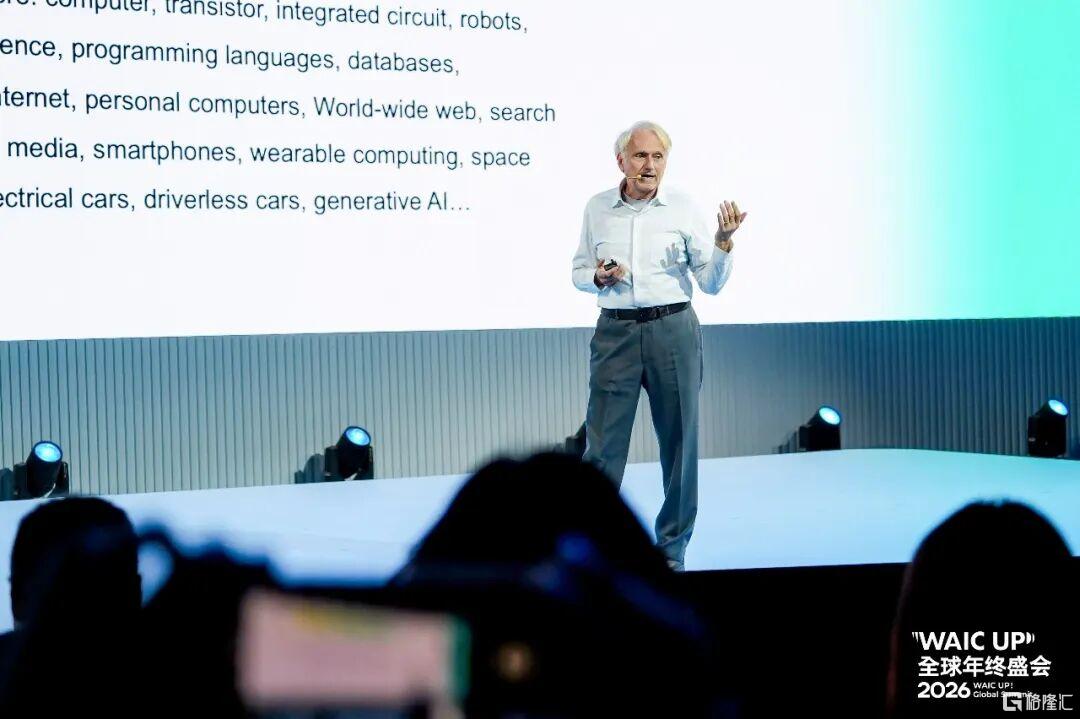
Piero Scaruffi at WAIC Up!
In a stand-out session featuring Piero Scaruffi, Director of the Silicon Valley Artificial Intelligence Research Institute, he argued that although 90% of generative AI projects are failing due to limited real-world applicability, he sees three areas where the technology will be transformative over the next decade: “One is software, writing software. AI is really good at writing software. Two, medicine, I can see that in 10 years from now, every hospital will have a chief data scientist or chief computer scientist or whatever. And then, scientific research. AI can accelerate scientific research.”
Scaruffi also predicts that sustainable AI is going to be the future in the next 10 years.“Somebody has to come up with models that don't require the gigantic data centers. And of course we know it's possible,”he said.“Somebody has to do it.”
He particularly emphasized the importance of cross-domain integration, and took Insilico Medicine, an AI-powered biotech firm as an example. By deeply integrating AI with drug research and development, Scaruffi said, the company has helped open new growth pathways for the industry. Looking ahead, he argued that this kind of integration will shift from exception to norm, becoming a key driver of AI’s evolution over the next decade.
Wei-Ying Ma, professor and chief AI director at City University of Hong Kong, echoed Scaruffi' s view on the growing role of AI in academic research. He introduced an in-house AI system that greatly improved research efficiency.“When I was a PhD student, I could only probably finish reading one paper per day, but now their productivity is 100 times bigger than mine,”he said. The university is now rolling out the system to around 3,000 PhD students.
The implications are profound. In the past, a doctoral candidates might spend three years verifying a hypothesis, including designing experiments, collecting data, analyzing results, and writing a thesis. Now, a round of verification can be completed in just 30 minutes or 100 seconds. The bottleneck in scientific research is no longer generating ideas, but how effectively researchers deploy AI to test and validate them.
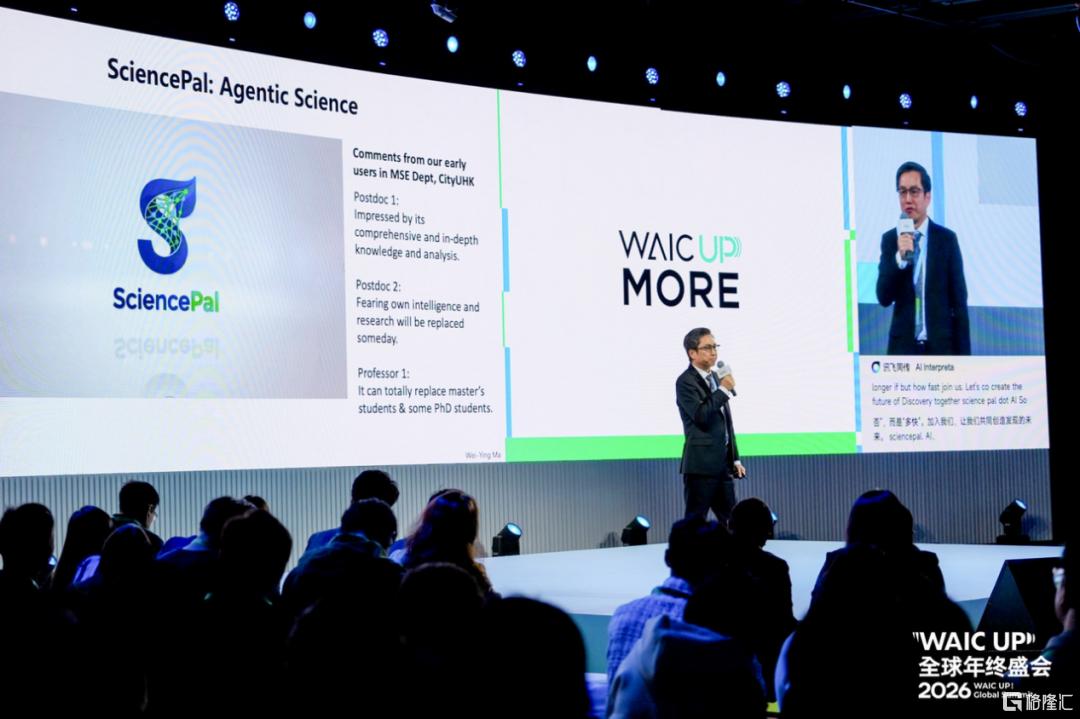
Prof.Wei-Ying Ma at WAIC Up!
Ma describes this shift as the "AI-intensive" era: not one in which AI merely assists scientific research, but one in which it fundamentally reshapes the entire search process. The dimension of scientific research competition is shifting from who is smarter to who is better at managing AI-driven scientific research agents.
The Silicon Valley Perspective: AI Is Building An Ecosystem that Drives Out All Other Applications
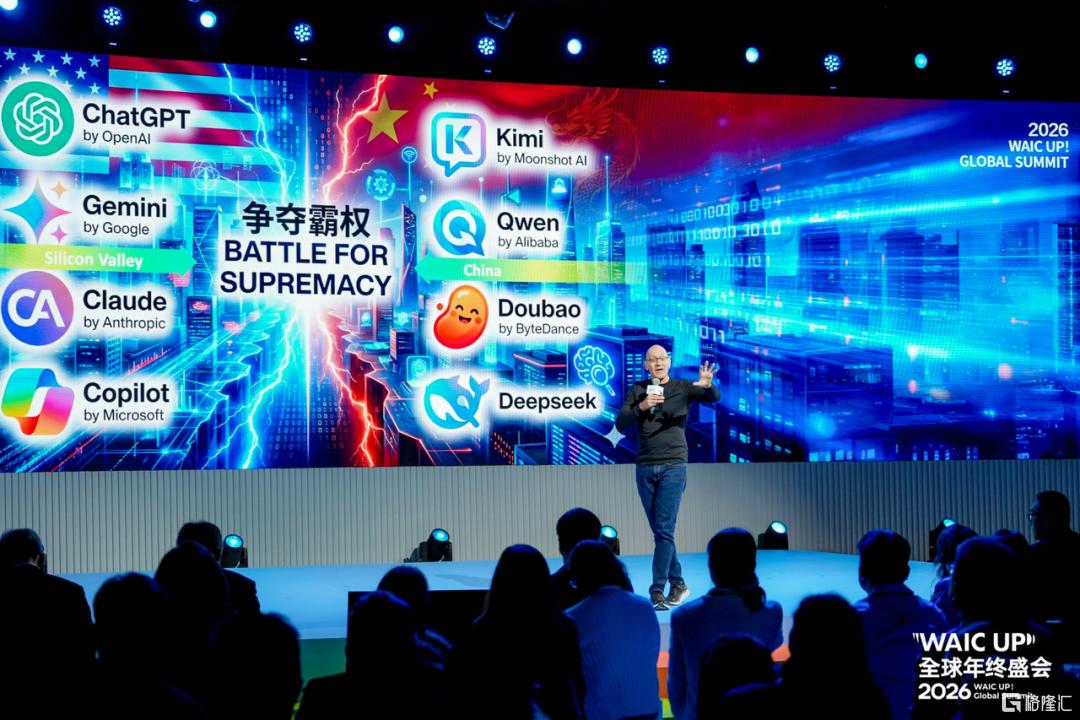
Steve Hoffman comparing all the AI companies
The presence of Steve Hoffman, known as "Captain Hoff", CEO of Founders Space, brought a pragmatic Silicon Valley lens to the summit. In his keynote,“Artificial Intelligence is Eating Everything,” Hoffman warned that the window for "wrapper startups" - companies that simply put a UI on top of OpenAI or Claude - has slammed shut.
" Right now, there's a battle for supremacy.” Hoffman said, as he ran through all the leading AI companies in the world.“They won't all win. Markets consolidate. There will probably be two big AI companies in the future,” he predicted.
“The models are all similar to companies that wins will be the ones that build the richest, deepest ecosystem, meaning not just the large language model, but the entire platform and what it can do for industry, how it integrates with industry, how many developers they bring on, how many consumers they bring on connecting those all together,” Hoffman told the audience.
Hoffman added that the ultimate winners are those integrating AI into the 'unsexy' industries—logistics, maritime trade, and elderly care. He pointed to OpenAI as being on the right trajectory, arguing that if search, shopping and social interaction can all be handled within ChatGPT, other companies risk being pushed down the value chain -from platforms to mere suppliers.
Last year, OpenAl launched Sora, a social feature within ChatGPT that allows users to interact and discuss content with friends - a move that extends the company in to the social domain. It enabled in-app purchasing within ChatGPT, opening an e-commerce entry point. At the same time, Open AI recruited a large number of device talents from Apple and signaled plans to move in to wearable devices extending AI beyond screens and into everyday use. Together, these efforts point to an ambition to build an "operating system for the AI era".
OpenAI's goal is very clear: to anchor social interaction through Sora, commerce through in-app purchasing, and everyday engagement through persistent AI interfaces positioning OpenAI not just as a model provider, but as the operator of users' digital lives.
Major tech companies have already grasped what' s at stake. Amazon prevented OpenAI from accessing its own data and even considered filing a lawsuit, the core reason being that it was worried of OpenAI seizing the e-commerce entry point. Hoffman also mentioned that Tencent and Alibaba jointly pushed back against the development of ByteDance’s AI mobile phones, driven by the same underlying concern: the risk of losing control over core business gateways. Hoffman said," The big companies know that AI is going to eat everything, and unless they control it, unless they control the interface, they will lose out."
Cheetah Mobile CEO Sheng Fu Envisions a Human-Centric AI Era at WAIC
Chairman and CEO of Cheetah Mobile and Chairman of OrionStar, Sheng Fu, shared a bullish outlook on the future of artificial intelligence and the transformative power of AI Agents.
In an exclusive sit-down interview with DataYuan addressing the debate surrounding scaling laws, Fu argued that while these laws are proven through practice rather than pure mathematics, the rapid evolution of models like Gemini indicates that the upper limits of model capacity remain far from reached. As long as global leaders continue massive investments in AI computing centers, he said, confidence in continued gains in model intelligence is unlikely to fade.
Fu also told DataYuan that the industry is shifting from a paradigm where humans must adapt to machines to one where machines revolve around humans. This transition is most evident in the rise of AI Agents, which Fu believes will redefine personal productivity.
While acknowledging that complex tasks like coding still require near-perfect accuracy to be viable, he highlighted that Cheetah Mobile is already successfully empowering AI in its core software. He cited the company' s overhaul of its legacy Clean Master and Kingsoft Antivirus software into an AI-driven computer assistant that can diagnose hardware issues and generate custom diagnostic code in real-time based on natural language prompts.
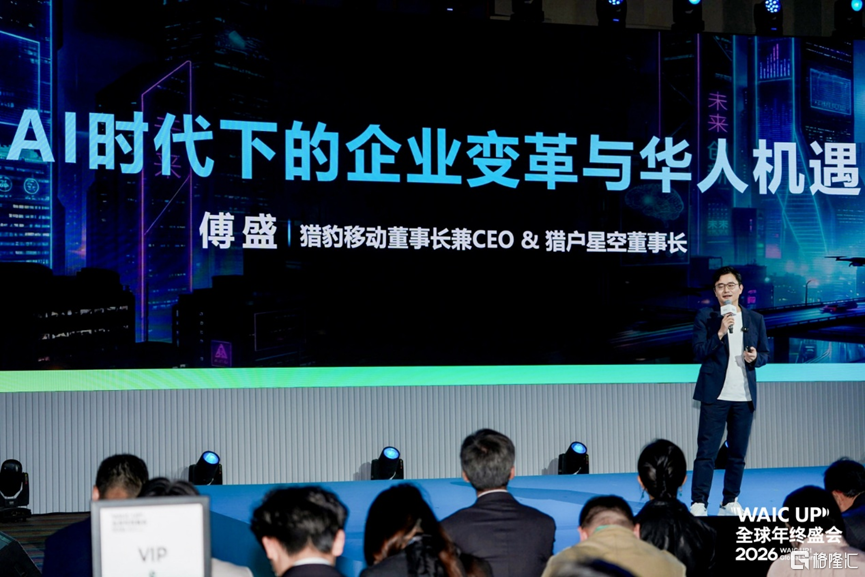
Sheng Fu at WAIC Up!
Beyond software, Fu identified the convergence of AI and hardware as a massive commercial opportunity, citing growing traction for AI-enabled products such as smart glasses and recording pens showcased at recent exhibitions.
For his robotics venture, OrionStar, the strategy remains "starting with the end in mind" , focusing on high-reliability service robots for restaurants and hotels-use cases where deployment is already practical.
Looking ahead, Fu believed that as the production of applications becomes easier through AI-assisted coding, competitive advantage will shift toward delivering seamless, intent-driven experiences, with AI agents evolving into ubiquitous personal assistants embedded in everyday life.
Business Breakthrough: The Global Expansion Playbooks of Chinese AI
On the exhibition floor, SenseTime, a leading global artificial intelligence platform headquatered in Hong Kong, showcased the latest evolution of its core strategy - "CV2.0". In the era of large language models, SenseTime combines its decade-long expertise in computer vision its self-developed, lightweight full-modal interactive model, SenseNova, build a full cognitive chain - from information collection "perception" to "understanding", "creativity", and then to “decision-making”. This upgraded architecture is now being extended across a broader range of real-world application scenarios.
Backed by this technical foundation, SenseTime has set its sights on the needs of all humanity, as its mission states: "adhere to originality and let AI lead human progress.” A representative of SenseTime told DataYuan that the company has been based in Hong Kong since its establishment and focuses on expanding its proprietary AI technologies globally. Currently, the company has a strong footprint across the Asia-Pacific and Middle East, supporting digital transformation and industrial upgrading in local markets.
Another exhibitor, Westwell, offered a more execution-driven perspective on globalization — grounded in operational data rather than strategy narratives. Yang Ming, CEO of Westwell Holdings (Hong Kong) Co., Ltd., the only prerequisite for Chinese private enterprises going global in the face of a complex external environment is that the technology and products themselves must stand out. Speaking at a roundtable forum, Yang added that selling products overseas alone is not globalization; real globalization means being part of local markets.
She took Westwell's practice in the UK market as an example: The company signed a large-scale port project with the largest port in the UK, deploying 100 autonomous vehicles, making it one of the largest single projects in this field. The system has been running stably for more than 700 days, improving the port efficiency by around 20%, reducing operating costs by 15%, and saving approximately 13,000 pounds per vehicle compared to traditional fuel vehicles.
"If our technology can compete, operate reliably and deliver measurable cost and efficiency gains in overseas markets, customers will adopt it." Yang Ming said.
Facing a complex global environment, enterprises of different sizes are also exploring differentiated paths to international expansion.
Haier, a Fortune Global 500 Chinese enterprise, is using its industrial internet platform, Haier CosmoPlat, to advance a model it calls “big enterprises build, small enterprises share.” According to Xie Haiqin, the deputy general manager of Haier CosmoPlat, the approach relies on large enterprises first validating systems, processes and industrial-internet capabilities domestically, before replicating those structures overseas — lowering barriers and risks for small and medium-sized firms entering global markets.
At another roundtable forum, Liu Jinglei, the vice president of China Mobile (Hong Kong) Innovation Institute, introduced China Mobile's platform-based overseas expansion. China Mobile International now operates 40 local units in five major regions around the world, serving as frontline hubs for understanding enterprise demand and embedding Chinese digital infrastructure into overseas business ecosystems.
The "Wake Up" Call
The 2026 WAIC UP! Global Summit proved that despite geopolitical tensions, the scientific community remains.
As the focus shifts from breakthroughs to deployment, the era of A implementation is now underway, and attention is turning to how this next phase will play out across global markets.
About DataYuan
DataYuan is a professional and in-depth media specializing in the innovative services for the data intelligence industry. It was co-founded by Mr. Zhang Yanfei in Beijing in 2015 who is also its chief editor. With the philosophy of “Changing Business with Data Intelligence”, DataYuan is dedicated to covering the news in the industry from the perspective of the application of data intelligent technologies.
Though based in China, DataYuan earnestly follows the news of its interests around the world. By closely following topics like the integration of such new technologies as AI, Cloud Computing, IoT, 5G and Blockchain with data applications and the business use cases of data intelligent technologies in the fields of finance, medicine, industry, consumption, etc., DataYuan expects to provide professional and profound content via new media as well as the most valuable business connecting services for the industry.
DataYuan now holds a number of self-owned media accounts to disseminate the content on the following media platforms in China and beyond, including WeChat Official Account, an official website on PC end, Toutiao, Baijiahao, Sohu, Zhihu, Snowball, Yidian, Tencent, IFENG, Netease, Netease lofter, Qutoutiao, BlogChina, 360Kuaichuan, Sina, Sina Weibo, Tumblr, Substack, Facebook, Twitter, etc.